
Van Winkle 13 Year Family Reserve Rye - Review
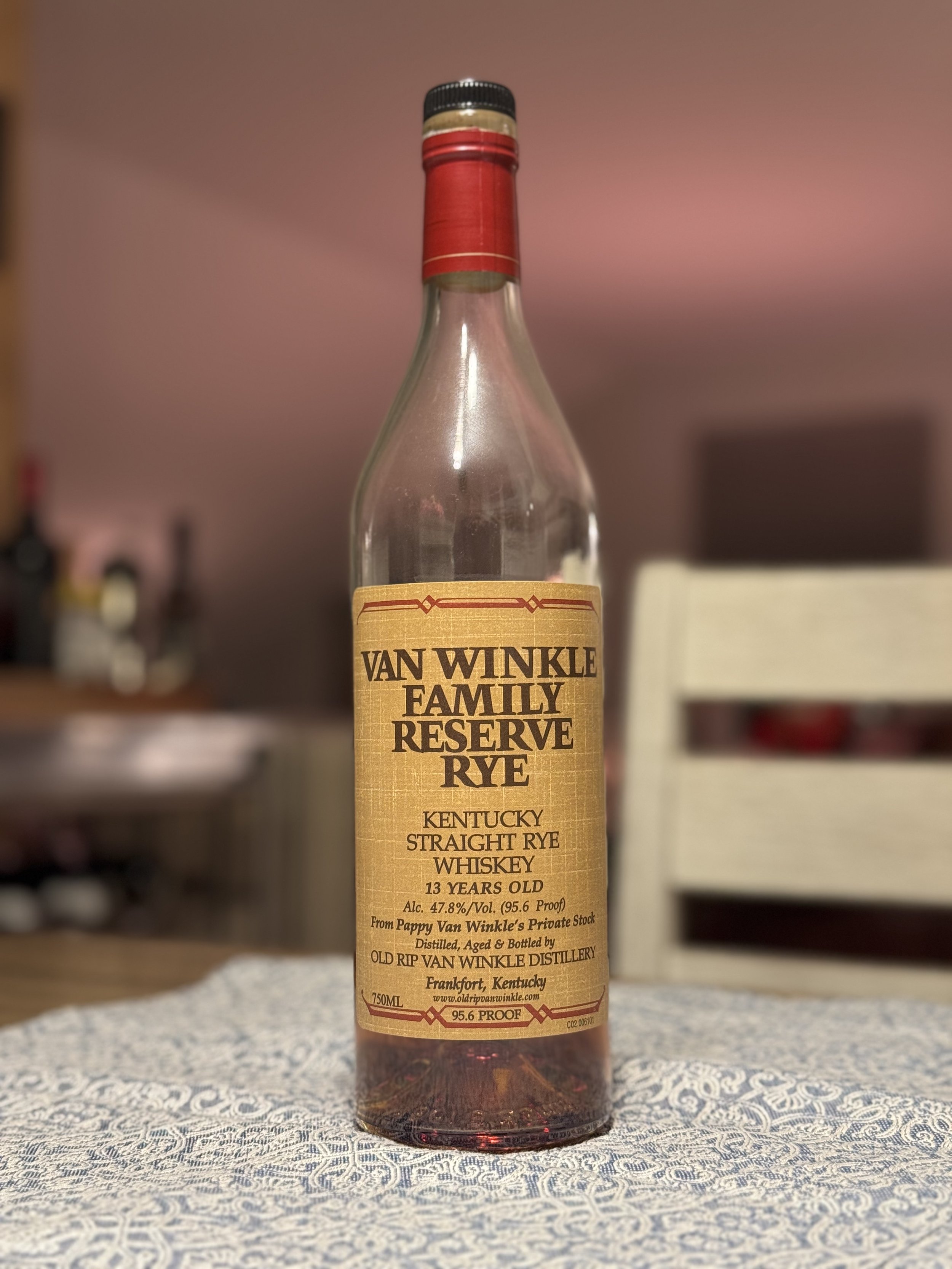
Folks, it has been over four months since my last review. I had to give up drinking for a while until I passed some exams and now we are back on track! In what better way to come back to reviewing than to try a pour of the Van Winkle Family Reserve Rye. One of my good friends, Ryan, actually got this bottle and was kind enough to trade some things for it.
Everyone toast to Ryan!! Anyways, to the review.
The story of the Van Winkle legacy is not merely one of whiskey production, but a narrative of survival, family conviction, and the definition of a "premium" category that did not exist when they began. The history of what is now known as the Old Rip Van Winkle Distillery began in 1893 when Julian Prentice “Pappy” Van Winkle Sr. took a job as a traveling salesman for the W.L. Weller and Sons liquor wholesale house.
In 1908, Pappy and a fellow salesman, Alex Farnsley, purchased the Weller firm. Shortly thereafter, they acquired a controlling interest in the A. Ph. Stitzel Distillery, which provided the whiskey for Weller’s brands. In 1935, following the repeal of Prohibition, the families opened the Stitzel-Weller Distillery in Shively, Kentucky. This site became hallowed ground for bourbon enthusiasts, famous for its unique "wheated" mash bill, which substituted the spicy bite of rye with the softness of wheat. Pappy famously placed a sign on the distillery gates that read: “We make fine bourbon. At a profit if we can. At a loss if we must. But always fine bourbon.”
Pappy helmed the distillery until his death in 1965 at the age of 91. His son, Julian Van Winkle Jr., took over, but the "Whiskey Glut" of the 1970s and pressure from family shareholders led to the sale of Stitzel-Weller in 1972. Crucially, Julian Jr. retained the rights to one pre-Prohibition brand: Old Rip Van Winkle. He began bottling aged stocks from the old family distillery under this label to keep the tradition alive. When Julian Van Winkle III took over in 1981, he operated as a "rectifier" and bottler, eventually purchasing the Old Hoffman Distillery in Lawrenceburg to house his aging barrels. In 2002, the family entered a joint venture with the Buffalo Trace Distillery, where the spirits are distilled and aged today under the family's strict supervision.
The 13-Year Family Reserve Rye
While the Pappy Van Winkle name is synonymous with wheated bourbon, the Van Winkle Family Reserve 13-Year-Old Rye holds a unique, almost legendary place in the portfolio. When it was first released in the late 1990s, it defied industry standards; at the time, rye whiskey was largely ignored, and almost no one was bottling it with a 13-year age statement.
The history of the liquid inside these bottles is famously complex. Unlike the bourbons, which were largely Stitzel-Weller or Buffalo Trace stock, the early iterations of the 13-Year Rye were sourced from the Medley Distillery in Owensboro. In 2004, Julian III blended the remaining Medley barrels with older rye from the Old Bernheim (Cream of Kentucky) distillery. To prevent this precious, ultra-aged liquid from over-oaking, he moved it into stainless steel "tanks" to arrest the aging process—a technique that became a hallmark of the label's early "tanked" lore.
Bottled at 95.6 proof, this expression represents a bridge between the old world of sourced "honey barrels" and the modern era. Since 2018, the offering has transitioned into a 100% Buffalo Trace distilled product, though it maintains the 13-year minimum age requirement. It remains one of the few non-bourbon releases from the family, serving as a testament to Julian III’s palate and his willingness to champion aged rye decades before it became a global trend.
Review:
Nose: I immediately notice cordial cherries and baking spices. There is quite a bit of barrel char that comes off on the initial nosing. Some honey and raspberries come off on the second nosing. It is very clear that this is a fruit forward rye. It packs a bit of a punch on the nose as well from the rye in the mash bill but the pepper note you typically get from a rye is lost behind the sweetness from the vanilla/honey and the fruits. I am almost getting more of a bourbon profile than I am a rye profile. Strangely with the age, I get a bit of ethanol on the nose, which you typically find with a more youthful American spirit, not one of 13 years of age.
Palate: Delightfully oily on the palate. The sweetness from the nose carries through to the palate where I get an iced tea note? Like some loose leaf tea leaves. Then following up some honey comes in with some sweet-tart like notes. After a few sips, I start to notice some black pepper on the front of the tongue, and it almost immediately converts to cinnamon and vanilla on the back end.
Finish: The finish is moderate on this. The sweetness lingers for a while but I almost get a tartness/oaky bitterness on the end. The warmth lingers with you for about 30-40 seconds after the sip but the notes start to dissipate only about 10-15 seconds in. The last note that I get with this is a dusty sweet corn note. I was hoping for a bit more on this.
Overall: (83). This rye can be seen as a bourbon fan’s favorite rye. It has almost all of the characteristics of a bourbon with just a bit of black pepper on the front of the palate and then splashes immediately back into a core classic bourbon profile. Are we dealing with an imposter? It was very refined and a very subdued pour in my opinion in many ways and I don’t think it took too many risks. I think this was made to please everyone. If you like rye, you’ll like this. If you like bourbon, you’ll love this. If you like whiskey, you’ll find this to be just an easy-going, complex enough sip that will make you want to revisit sip after sip to see if there is anything else there.
Value: 50/100; (-2 on the overall). I paid $200 for this. That is steep nowadays with how many competitors are out there. Is it worth that price? I’d say so. I wouldn’t pay any more however. Is it worth the $900 that this goes for on the secondary market? Not even remotely. I’d say if you can find this bottle for retail, it is worth it and is a fun conversation starter. If you are hunting for it and see it for secondary, you can start an arguably outstanding rye collection alone off of what you would pay for one bottle of this.
Availability: Unicorn. This you can only get for MSRP if you “know a guy” or win a lottery. Try to do the former! If you have a good relationship with a store, they will tend to hook you up with a bottle of this caliber from a “sought-after” standpoint.
Citations:
https://www.buffalotracedistillery.com/our-brands/van-winkle/van-winkle-family-reserve-rye.html
https://www.sothebys.com/en/articles/the-comprehensive-collectors-guide-to-van-winkle-bourbon
http://tokyobourbonbible.blogspot.com/2015/05/van-winkle-family-reserve-rye.html
https://gardenandgun.com/feature/julian-p-van-winkle-iii-the-arbiter-of-taste/
